There is a wide range for AI app development costs in 2026, with projects in India generally starting at around ₹5 lakh and reaching ₹20 lakh or more. An MVP with a few AI features and an existing model can fit towards the lower end. Projects become considerably more involved when they need custom AI, large amounts of data, several system integrations, complex workflows or enterprise-level security.
The cost of AI app development also depends on the chosen platform and the scale at which the application will operate. Tekniko Global can help businesses review these factors and set a practical development scope. The initial project cost does not include recurring AI API, infrastructure and maintenance expenses.
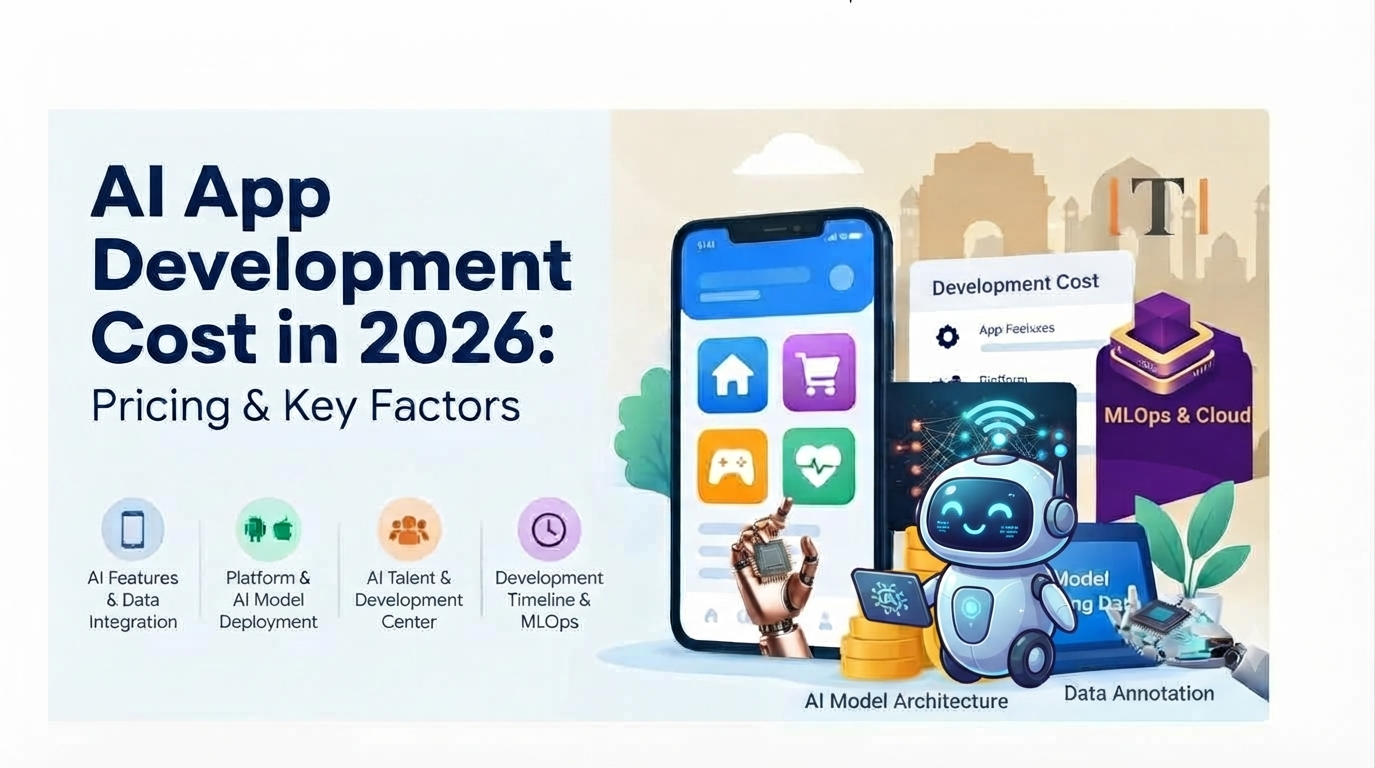
AI App Development Cost in 2026 at a Glance
The AI app development cost depends on the overall level, from a focused MVP to a large enterprise system. The table below gives a quick view of what each stage usually covers, along with the estimated development timeline.
| App Level | Cost | Typical Scope | Timeline |
|---|---|---|---|
| Basic AI MVP | ₹4L–₹6L | API-powered chatbot, automation, basic AI features | 2–4 months |
| Mid-Level AI App | ₹8L–₹12L | RAG, personalization, multiple workflows | 3–6 months |
| Advanced AI App | ₹12L–₹20L | Advanced AI, complex integrations, custom workflows | 5–9 months |
| Enterprise-Grade | ₹30L–₹40L+ | High scale, governance, multiple systems | 8–12 months |
Basic AI MVP
A basic AI MVP usually zooms in on one clear use case. Existing AI APIs can carry the main intelligence, while a standard backend supports the whole thing. The first round might come with a chatbot or some simple automation, or even another constrained AI feature. Integrations stay relatively few, and the project should need only minimal custom AI work.
Mid-Level AI App
A mid-level app covers multiple workflows and generally has an expanded feature set. RAG or personalization may be included in the product. More data and integrations will likely exist. You will also need to test more user journeys.
Advanced AI App
Advanced applications also need more involved AI capabilities and custom workflows. Real-time processing and some tricky system integrations can end up being part of the build. The testing phase then gets broader because the app has to give reliable outcomes across many different scenarios.
Enterprise-Grade AI App
Enterprise projects cover a much wider environment. Multiple systems may need to exchange data, and the application may have to support high user volumes. Governance, security and high availability are key parts of the project scope.
AI App Development Cost in India: What Changes the Quote?
The AImobile app development cost in India depends partly on who takes responsibility for the project. A freelancer, small AI team, development company and enterprise team operate with different resources and levels of specialization. Businesses looking for an AI mobile app development company in Noida may encounter all four options, with each offering a different approach to project delivery.
The following comparison shows how the development setup can affect the pricing structure:
| Development Option | Indicative Rate | Pricing Characteristic |
|---|---|---|
| Freelancer | ₹700–₹1,500/hour | Lower initial labor cost |
| Small AI Team | ₹1,200–₹2,500/hour | Moderate cost for focused projects |
| AI Development Company | ₹1,500–₹3,500/hour | Broader skill coverage |
| Large Enterprise Team | ₹2,500–₹4,500+/hour | Higher cost for complex delivery |
These are indicative 2026 India development rates, not fixed project prices.
A smaller team might keep the initial labor cost lower, but a larger team could bring more specialized roles into the project. The quotation needs to be looked at alongside the expertise and the delivery capacity that is included in it.
AI App Development Pricing by AI Use Case
AI app development pricing varies with the type of AI functionality an application needs. A chatbot, predictive system and computer-vision application can require very different development approaches. The following use cases show how the nature of the AI feature can shape the overall development scope.
| AI Use Case | Indicative Cost | Common Applications | Main Cost Drivers |
|---|---|---|---|
| Generative AI | ₹8L–₹20L+ | AI assistants, copilots, content and document generation | Context, business data, workflows |
| Conversational AI | ₹7L–₹15L+ | Support bots, virtual assistants, multilingual chat | Conversation complexity, integrations, languages |
| Predictive ML | ₹8L–₹15L+ | Forecasting, scoring, demand prediction | Historical data, modeling, data preparation |
| Computer Vision | ₹10L–₹40L+ | OCR, image recognition, visual inspection, video analysis | Labeled datasets, processing, compute |
| Voice & Multimodal AI | ₹8L–₹20L+ | Voice assistants, speech processing, text + image apps | Audio processing, input types, real-time needs |
| Agentic AI | ₹10L–₹20L | AI agents, automated tasks, multi-step workflows | Tools, memory, workflow complexity, safeguards |
Generative AI
Generative AI can power AI assistants, copilots, content-generation tools and document-generation features. The development scope changes with the type of output and the amount of business context the application needs to handle. A simple content tool may have a smaller scope than an assistant built around detailed business information.
Conversational AI
Customer-support bots and virtual assistants need to respond to user questions and retain the relevant details from a conversation. CRM and helpdesk integrations add another layer to the application. Also, handling multiple languages or longer conversational flows can increase the cost of AI app development.
Predictive ML
Predictive ML applications use historical data to produce forecasts, scores and predictions. Demand forecasting, sales prediction and risk scoring are common examples. Data preparation and model development form a major part of the work because the application needs relevant information for the prediction it is designed to make.
Computer Vision
Computer vision can handle image recognition, OCR, visual inspection and video analysis. Labeled datasets may be needed for training and validation. Video-based applications can also require greater processing capacity because they analyze visual information continuously.
Voice, Multimodal and Agentic AI
Voice applications take spoken input, and multimodal systems can deal with text, pictures and audio. Meanwhile, agentic AI brings in tool calling, memory, and multi-step workflows so the whole application can tackle more involved jobs. But once the system is allowed to take actions or connect with other tools, safeguards and thorough testing matter a lot. For businesses considering an AI mobile app development company in Gurgaon, the scope can vary depending on the capabilities they choose to include.
Where Does the AI App Development Budget Go?
The AI app development cost reflects the work that is happening throughout the development process. Planning, product design, coding, AI implementation, testing and then deployment each play a role in getting the application actually ready for launch.
Planning and Discovery
The team first establishes the product requirements and defines the AI use case. Data availability and technical feasibility are checked before the system architecture is decided. This work includes:
- Requirements
- AI use-case definition
- Feasibility assessment
- Data audit
- Architecture planning
UI/UX Design
The interface needs to support the way users interact with AI features. Designers also plan what users see during processing, after an error and when the AI cannot complete a request. The design stage covers:
- User flows
- AI interaction
- Loading states
- Error states
- Fallback experiences
Frontend and Backend Development
The frontend includes the screens along with any functionality that the user will interact with. Backend refers to the logic of the application that occurs behind the scenes. Development can span APIs, databases, authentication, user management, etc. These work together so that your interface can hook into your data and services required for your application to operate.
AI Development and Integration
The AI layer is added to the application according to the planned functionality. The technical work may include:
- Model/API integration
- RAG implementation
- Fine-tuning
- AI workflows
- Validation
Testing and AI Validation
The testing stage checks if the app works properly and if the AI behaves as it is supposed to. Functional QA, AI output checks, accuracy testing, edge case reviews and security checks help spot problems before the application goes live.
Deployment
After testing, the application is set for production. The team configures the cloud environment, wraps up the production settings, and sets up monitoring before the launch. These steps help prepare the application for real-world use rather than limiting it to a development or demo environment.
What Factors Affect the Cost of AI App Development?
The scope of an AI application can change significantly depending on what sits behind its main AI function. Data may need to be collected and prepared, existing systems may need to be connected, and complex workflows may need to be built around the AI. Security, accuracy, team expertise and user scale add further considerations. Looking at these factors individually gives a clearer picture of why project quotations differ.
1. Data Readiness and Volume
How your data will fit into your project depends on what it looks like. Clean data is easier to prepare than a mix of documents and files with missing information. The more data you have, the more you may also have to process it for your AI model. Gathering your data, cleaning your data, labeling data, OCR and creating a data pipeline could all play into your initial scope.
2. App and Workflow Complexity
The amount of workflow and business rules that you want to add to your application with the AI will affect how much time is needed to develop. If you have one user flow that is simple, it will take less time than if you have many user types and dashboards and admins.
3. Third-Party Integrations
When building out connections to current systems, it can create more development time. There can be multiple CRMs, ERPs, payment gateways, and EHR systems. Each one may have its own APIs and information formats. Also, if you are building out internal APIs or have legacy systems, you will need to take that into account. Data mapping and authentication will also come into play when trying to communicate information from system to system.
4. Security, Privacy and Compliance
When dealing with confidential data, there may be more considerations when building your AI application. This can require features such as:
- Encryption
- Access management
- Audit logs
- PII handling
- Industry-specific requirements
- Explainability where relevant
5. Accuracy and Reliability Requirements
The required level of AI accuracy can influence how much testing is needed. If your feature is more generic, you may not need to do as much testing. However, if the output of your AI can have impacts on key business processes, you may want to ensure that it is accurate. Higher requirements can involve accuracy targets, edge-case testing, human review and failure handling.
6. Development Team and Expertise
Depending on your app, you will need various people to help build your product. If it is just a simple application, you may only need one or two developers. But if you want to get into more advanced areas of AI, you may need someone for each category listed below:
- Product manager
- Front-end developer
- Back-end developer
- ML Engineer
- Data Engineer
- QA Engineer
- DevOps or MLOps Engineer
7. Expected User and Performance Scale
It will also depend on how many users your application will have. There is a difference between building an app that will be used internally and one with high concurrency. If you need your application to be more responsive or process information in real time, this could add to the complexity of your application when building.
The final quotation therefore reflects the amount of work and expertise required to build the application, rather than the AI feature alone.
Custom AI App Development Cost: Which AI Architecture Should You Choose?
The custom AI app development cost changes with the AI architecture selected. The main difference comes from how much of the AI stack needs to be built, configured or controlled.
Here is how the common approaches compare:
| AI Approach | Upfront Complexity | Best Suited To |
|---|---|---|
| Pre-built AI API | Lowest | Common AI functionality |
| API + RAG | Low–medium | Private or changing knowledge |
| Fine-tuning | Medium–high | Specialised behaviour |
| Custom Model | Highest | Proprietary AI requirements |
| Open-source / Self-hosted | Variable | Greater control and specific workloads |
A pre-built AI API lets the application use an existing model without developing and training a model from scratch. RAG incorporates a document retriever and may use a vector database, so your application can retrieve relevant information to include before responding. Fine-tuning requires a training dataset and model-specific training work. Custom models require model building. Self-hosted models require you to also manage your own deployment and infrastructure.
Android AI App Development Cost and Platform Choices
The Android AI app development cost changes if your AI feature requires direct access to Android hardware or device-level processing. Camera-based vision, microphone input, offline AI, and on-device inference may need extra Android development and device testing.
Native Android vs Cross-Platform
Native development is suited to applications that depend heavily on Android functionality. Flutter or React Native can be useful when the product is planned for both Android and iOS and the AI layer can be shared across platforms.
On-Device vs Cloud AI
On-device AI needs model optimization for supported Android devices. With cloud AI, the phone sends the required input to a remote service and receives the result through an API. The choice is therefore part of the technical scope for an AI app development company in Delhi NCR.
What Are the Ongoing Costs After Launching an AI App?
An AI app can continue generating costs long after the development team delivers the first version. The recurring budget mainly covers AI consumption, the infrastructure running the product and the technical work needed to keep everything functional.
| Ongoing Cost | Estimated Monthly Cost |
|---|---|
| AI API & inference | ₹10,000–₹5,00,000+ |
| Cloud & backend | ₹10,000–₹2,00,000+ |
| Vector database & AI infrastructure | ₹5,000–₹1,00,000+ |
| Monitoring & security | ₹5,000–₹75,000+ |
| Maintenance & support | ₹20,000–₹1,50,000+ |
These are indicative ranges and vary by usage, model, and infrastructure.
The range is wide because an AI app's monthly usage can vary substantially. A small app may generate limited API and hosting charges, whereas a high-traffic product can consume considerably more compute and model capacity. RAG introduces additional storage and retrieval costs, and an AI mobile app development company may bill maintenance separately.
How to Reduce the Cost of AI App Development
The cost of AI app development can often be controlled before coding even begins. Defining the essential AI workflow, choosing the right model and deciding which features can wait will give the development team a narrower scope to work with.
Some simple changes can make a noticeable difference:
- Begin with the features users need most.
- Use pre-built AI APIs instead of custom models where possible.
- Match model capability with the actual task.
- Add complex features after the first release.
- Check the scope carefully when comparing an AI app development company with other providers.
Conclusion
What you spend on an AI application depends on more than the AI model. Features, data, architecture, integrations, platform and expected usage all contribute to the AI app development cost. Defining these requirements early can give you a clearer idea of the investment involved Tekniko Global can help you evaluate your requirements and plan the development process. Contact the team for a project-specific consultation.
FAQs
How much does it cost to develop an AI app?
The cost of developing an AI app in India can start at around ₹5 lakh and go up to ₹75 lakh or more. The final amount depends on the AI features, app complexity, integrations, data requirements and development scope.
What factors affect the cost of AI app development?
The scope of the AI feature matters first, followed by the application itself. Data preparation, third-party integrations, security, platform requirements, testing, and the chosen AI architecture can all add to the development effort.
How much does it cost to integrate AI into an existing app?
The cost can fall between ₹2 lakh and ₹15 lakh or more. A simple API-based feature needs less development than an AI system that must search private documents, process images, or manage multi-step tasks.
How long does it take to develop an AI app?
A basic AI app can take around 2–4 months to develop. More advanced applications can take 5–9 months, depending on the number of features, integrations, testing requirements, and overall technical scope.
What is the cost of maintaining an AI app?
Monthly maintenance alone can fall between ₹20,000 and ₹1.5 lakh or more. The figure depends on the amount of support required. AI model usage, cloud infrastructure, monitoring, and other third-party services can add separate recurring charges, making the total monthly operating cost higher.